
Need some rainy day games or indoor recess activities for kids?
Want to learn the magic of Silent Ball on a rowdy group of kids? Or have you worn out the tried and true Silent Game and need a new challenge?
I’ve been a Movement/Yoga/Mindfulness teacher of kids for over 6 years now, and I have taught yoga in a variety of settings, including schools and community programs. I know that not every kid likes yoga. But most kids love group games! Teachers can use these games in school environments to engage students and make yoga fun and interactive.
These activities are great examples of kid’s yoga games, which are designed to make yoga engaging and accessible for children. Children’s yoga focuses on playful, age-appropriate yoga sessions for kids, integrating movement, mindfulness, and social-emotional learning.
(Some days I’m tired of yoga myself and we just need to play games.) Adding a ball into the mix works wonders and can perk up a group of even the most bored and tired kiddos, especially in school classrooms or other tight quarters.
The time had come to create a few group games and make them fit into my yoga and mindfulness curriculum.
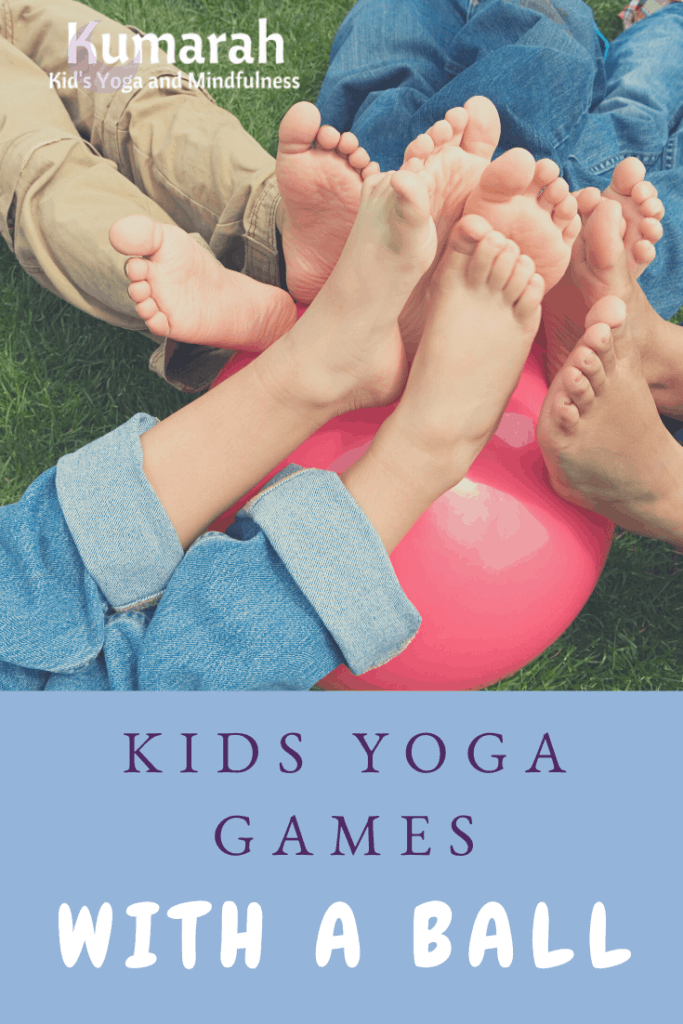
Yoga games using a ball maybe don’t seem very much like yoga, but it definitely works as an exercise that gets kids moving and engaged.
These games can become regular practices for children, helping them build healthy habits and enjoy yoga as part of their routine.
Almost any game can be modified a little bit to emphasize stretching, strength, or mindfulness, which are all a part of practicing yoga in a playful, interactive way!
If you don’t have a lot of space, it’s important to have games that can be done in tight quarters.
Many kids yoga classes are also meant to be a little quieter, or if you are in a classroom, you might need to be mindful of the spaces around you.
Preparing for Yoga Games
Getting ready for yoga games is just as important as the games themselves! A little preparation goes a long way in making sure your kids yoga session is fun, safe, and full of learning.
Whether you’re teaching yoga in a classroom, at home, or in a studio, start by gathering all the essentials: yoga mats for each child, a set of yoga cards or pose cards, and some upbeat music to set the mood. If you’re planning to use props like balls or balloons, have those ready too.
Before you dive into the games, take a moment to set clear ground rules and explain the objectives. Kids thrive when they know what to expect, and easy to follow instructions help everyone stay focused and engaged.
For example, let them know how to play each yoga game, how to pose correctly, and what to do when the music stops. This is especially helpful for group activities like “Red Light, Green Light Yoga,” where older kids can enjoy the challenge of holding different poses when you call out “green light” or “red light.”
When planning your yoga games, consider the age and energy level of your group. Younger kids love simple, repetitive games that spark their imagination—think animal yoga poses or playful yoga stories. As kids get older, you can introduce more complex games that build teamwork, balance, and coordination.
Games like “Yoga Memory” with kids yoga cards are perfect for helping children learn and remember different poses, while also practicing mindfulness and social emotional learning.
Setting up your space is key to a smooth session. Arrange yoga mats in a circle or rows, depending on the game, and make sure there’s enough room for everyone to move safely. Using music adds energy and excitement, while props like balls or yoga cards bring variety and added fun to your activities.
Don’t forget to include breathing exercises to help kids transition from high-energy play to calm, focused mindfulness.
Being prepared and flexible allows you to create a positive environment where kids can play, practice, and grow. With the right materials and a thoughtful approach, you’ll help kids develop important skills like focus, balance, and self-awareness—all while having a blast. Whether you’re a teacher, parent, or yoga instructor, your preparation sets the stage for memorable yoga games that enrich children’s lives and make every class a joyful experience.
Here’s a list of more competitive group games, several of them are very yoga friendly!
Silent Ball
Yep, this is a classic game and it works with most groups like magic. I play with my kids frequently because it also requires them to be mindful, use focused concentration, good eye contact, and have awareness of body language.
It also gives me like 10 minutes of blessed silence, which, when I have 9 classes of 40 minutes back to back I really need some silence occasionally.
All kids stand, in a circle, or wherever they choose. Pass the ball to each other without talking. The game encourages taking turns and cooperation among the kids. If you talk, you are out. Emphasize the importance of paying attention and using good eye contact.
Other rules for Silent Ball:
- If you make a bad throw, you are out
- Dropping the ball or missing a good catch gets you out
- Being a poor sport gets you out or keeps you out
- Only the teacher or the “caller” decides who is out or in
You can add additional “challenges” too. The top three are always in effect, but you can add these one at a time to make it more interesting and add a level of focused concetration as well:
- Throw AND catch with one hand behind your back
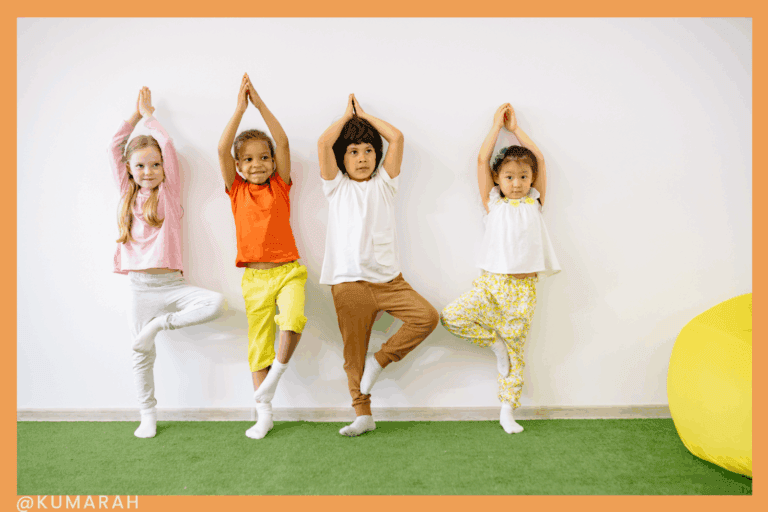
- Stand in tree pose
- Close one eye
- Overhead throws with two hands only
- Boy-girl pattern (only throw to a person of another gender)
- Long sleeve/short sleeve pattern
- Snake eyes only (look at one person but throw to another)
Arm Hockey
This is an entertaining competitive game with a ball that has the added bonus of a good forward fold.
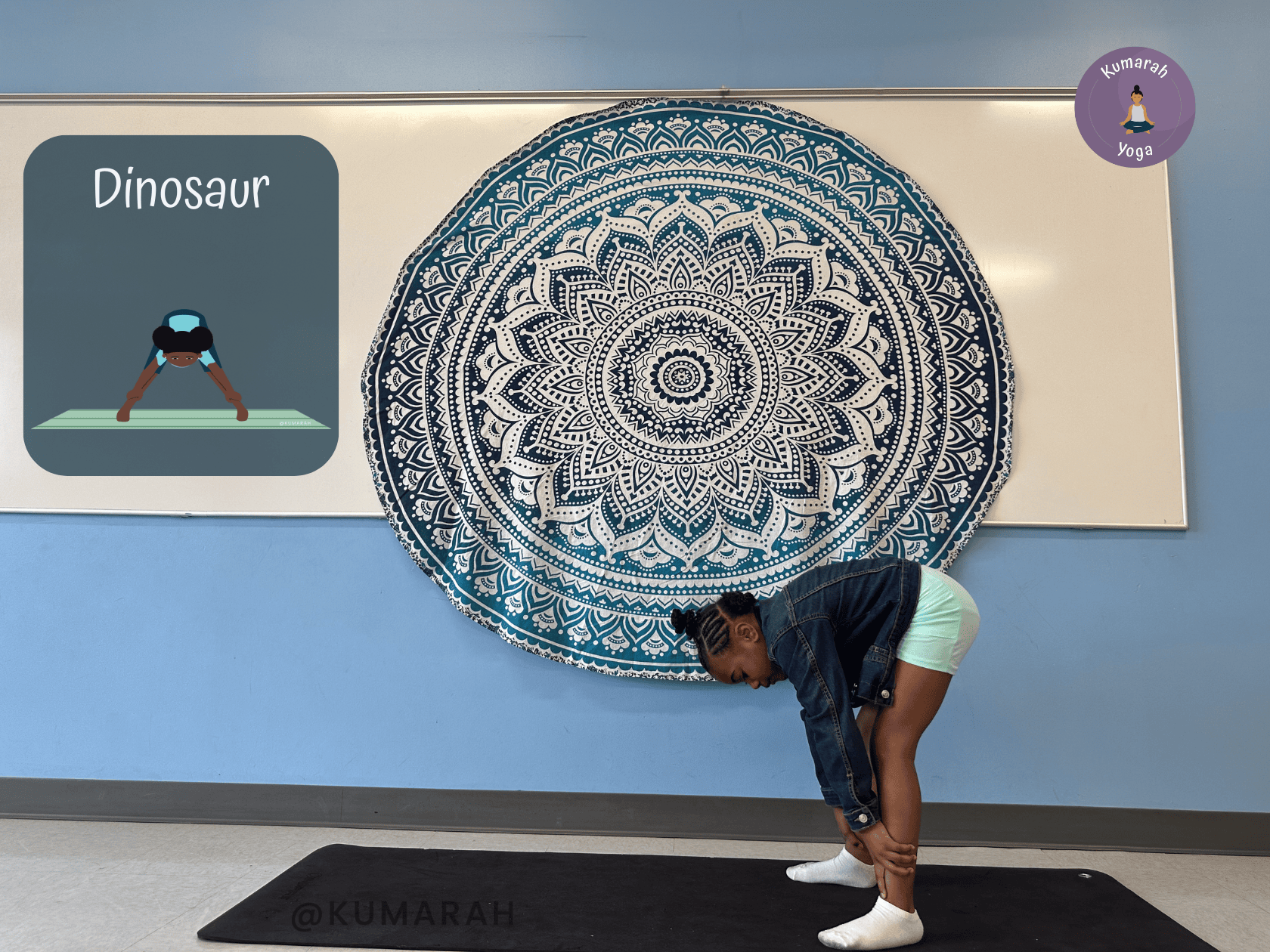
Prep for the game by teaching kids wide-legged forward fold (the yoga element!). Feet are glued to the ground wider than hip distance apart, toes facing forward. Bend at the hips to lean forward and reach the ground. You may bend your knees slightly.
Once they all know that pose, get them into a circle with their feet touching the person next to them.
For larger classes, consider dividing the children into smaller groups to play the game. This helps keep everyone engaged and makes it easier to manage.
This is the hardest part.
It works have them sit in a circle first, then stand up one at a time and place their feet apart. The next student to stand up matches one foot to the other person’s and stands with their feet far apart as well.
Once in the circle with all the kids standing in a wide stance and their feet touching their neighbors, each student will effectively have made a “goal” that is between their legs.
A ball is in the middle and gets rolled across the open space by the kids to try to score a goal by getting it between someone else’s legs. They also have to protect their own goal by hitting the ball away from their legs as it gets closer.
Rules for arm hockey:
- Push the ball with a flat hand (not your fist)
- Keep the ball on the floor
- Glue your feet to the floor (this is really tough, as they automatically want to step into the circle to get closer to the ball to hit it)
- Keep the ball moving (don’t grab it or stop it)
When the ball goes between someone’s legs they are “out” and either leave the circle or can sit down in wide-legged forward fold.
If they do the latter they can still play as long as they don’t grab the ball. This is sometimes the better choice because readjusting the size of the circle can be tricky.
Add in more balls as they get better at it for added fun and excitement!
Plank Ball
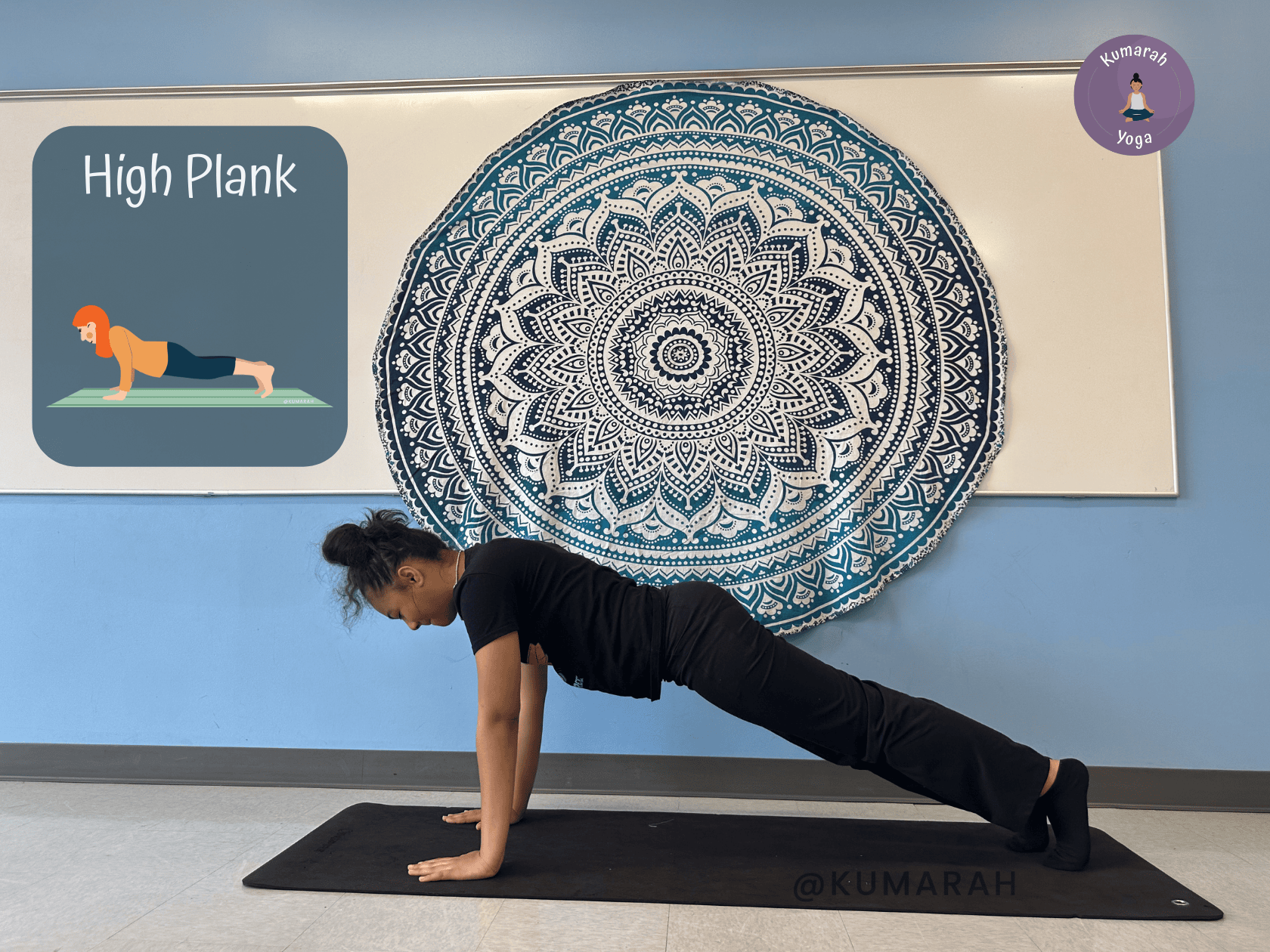
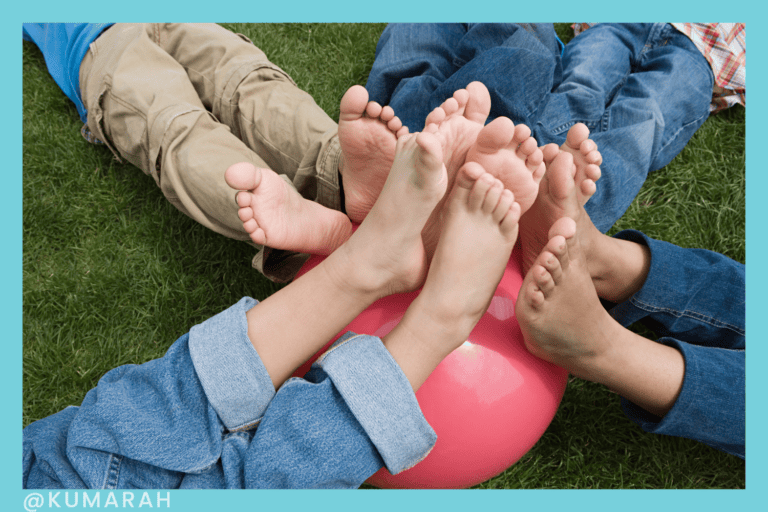
This is like tennis, but with the ball on the floor, and the court is the yoga mats. Also, you guessed, you have to be in plank the whole time!
Most of the time I let the kids play one on one, or in pairs. If you only have one or two balls for the class, you can get in a circle and play it a lot like Arm Hockey as well. (That way they can also take breaks if they get tired.)
First, teach them a proper plank pose, shoulders over hips and in line with heels.
If holding plank is too advanced for them, you can also play it in table top. Give them reminders about engaging their core, and maybe encourage them to have one foot straight back the whole time.
If in pairs, have one child at either end of the yoga mat, facing each other. Plank time! Pass the ball back and forth. If one student misses, the other gets a point. If one student falls or lowers down, the other gets a point. Let the kiddos help you come up with other rules and expectations too!
Add a challenge of keeping the ball on the yoga mats the whole time (out of bounds means the other kiddo gets a point!)
Legs up the wall/Plow ball pass
This game works great with a variety of groups of students as it can be for a larger group, or for pairs.
The object is the pass the ball only using your feet as many times as possible without the ball falling.
It requires strength, coordination, and concentration– all great yoga elements.
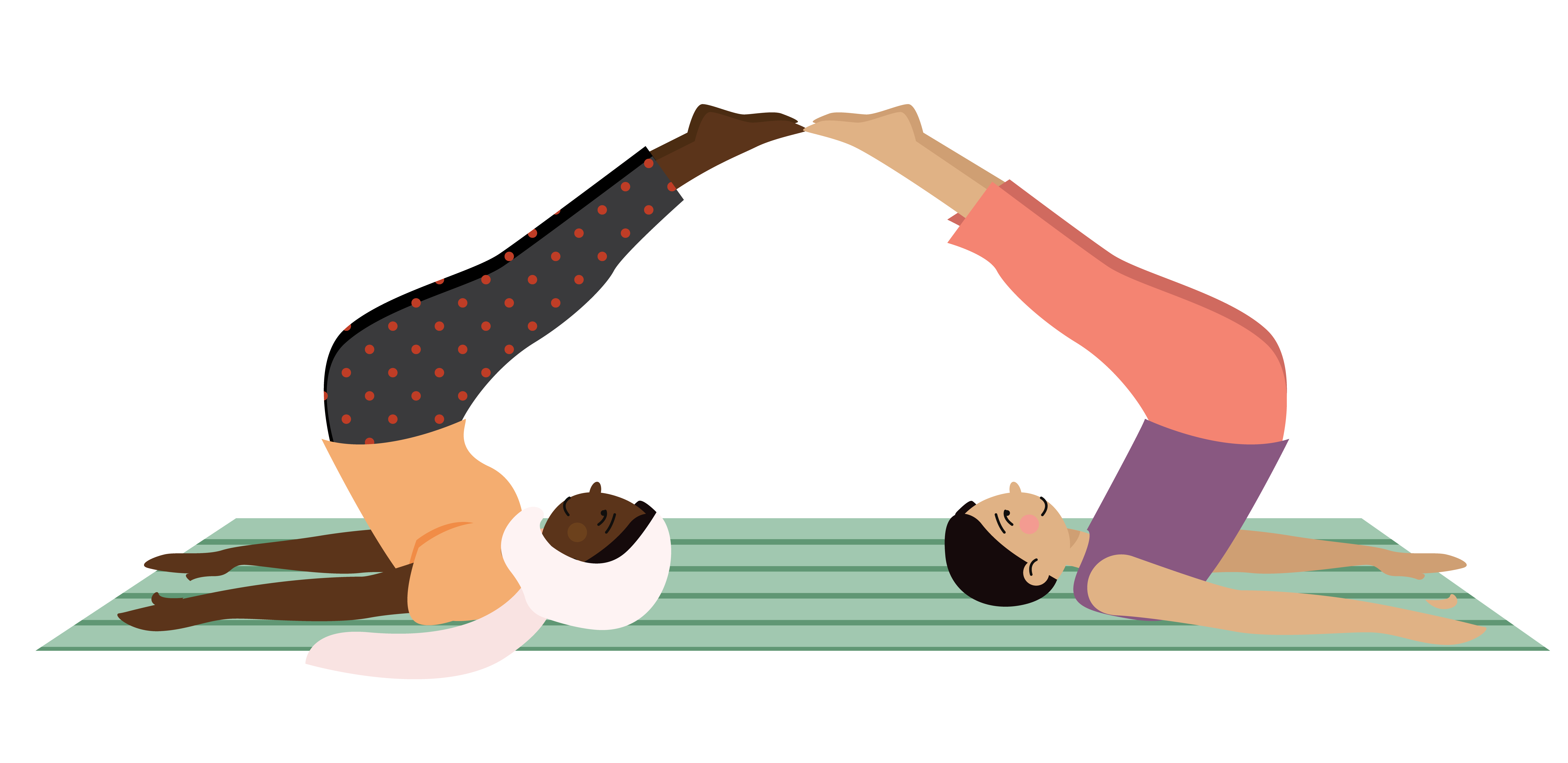
Lay on your back with your feet straight up and hands by your sides or supporting your low back to lift your hips higher. If they are all lined up against the wall, pass the ball down the line and back again.
If you’re in a circle, see how many times you can pass the ball around the circle without dropping it.
For pairs, have the kids lay head to head and go from low boat to shoulder-stand essentially, passing the ball back and forth as many times as possible. This activity helps kids practice transitioning between different poses.
This game also works with yoga blocks instead of a ball!
Hot Potato
A classic game with a ball. Or a beanie baby, or a block, or something a tiny bit fragile so they have to be super careful! Hot Potato is often played in kids yoga classes to encourage movement and focus.
Stand or sit in a circle. Start some music and pass the “potato” as quickly as you can. When the music stops, the kiddo with the “potato” is out. If you throw the potato, or fail to catch the passed potato you may also be out (lack of focused concentration in either case).
You can look up the music for “Hot potato” if you want, there are some good tracks on Spotify.
You can the rule of silence, if needed. (I usually need it!!)
Earth / Air / Sea
This game is best for older kids (ages 10+), since it requires more thinking as well as coordination.
It’s another game with a leader in the middle. As the leader passes the ball to a player they say either “Earth,” “Air,” or “Sea.”
The person who catches it must name an animal or a thing that resides within that realm. (Earth-wolf, air-robin, sea-dolphin, etc.…).
If they fail to name an item within 3 seconds, they are out. If they name something that is not correctly qualified, they are also out.
With my 5th grade students we eventually added the rules of:
- no immediate repeats
- no repeating what you yourself said
- no proper nouns
Some of them got really clever and creative!
Memory Pass
This is a great game of concentration and, eventually, speed. Everyone starts standing. You throw the ball to someone else, and then sit down. Your job is to remember who threw it TO you.
Once everyone is seated, the game starts again but in reverse. The game continues until everyone is standing again.
Everyone stands up again as they receive the ball, and the last person that received the ball, throws it to the person that threw it to them, and so on, standing up as you go.
If it gets back to the person who started and everyone is standing again, you win!
You can play this game with kids as young as Kindergarten, but it takes a lot of extra explaining. 2nd grade and up works best.
Add the extra challenge of having voices off the whole time, and timing the process to see how quickly you can go.
Push and Catch
This game is silly and fast paced. The leader (in the middle, or on one side of a row) has the ball to start. As they throw it to someone, they shout either “push” or “catch.” The person receiving must do the OPPOSITE of the action called out. If they fail the task, they sit down.
The leader can rotate so that other students have a chance to participate in different roles, encouraging everyone to be engaged in the activity.
It helps to have one person assigned as the “runner” to catch the ball if it was not caught. (It’s a good idea to choose the kid who has way too much energy to follow directions in the first place).
Block Bowling
Set up 10 blocks like bowling pins. To make the game more creative and engaging, kids can draw yoga poses on the blocks before playing. Take turns rolling the ball into the blocks to knock them all down! Go more quickly with two sets of 5 blocks and a bowling “competition.”
Try some other bowling challenges, like:
- Use your non-dominant hand
- Between your legs (forwards)
- Backwards between your legs
- Spin three times first
- Close one eye
- From Tree Pose (or triangle, or warrior 1, etc…) — poses for challenges should be preferably based on traditional yoga positions
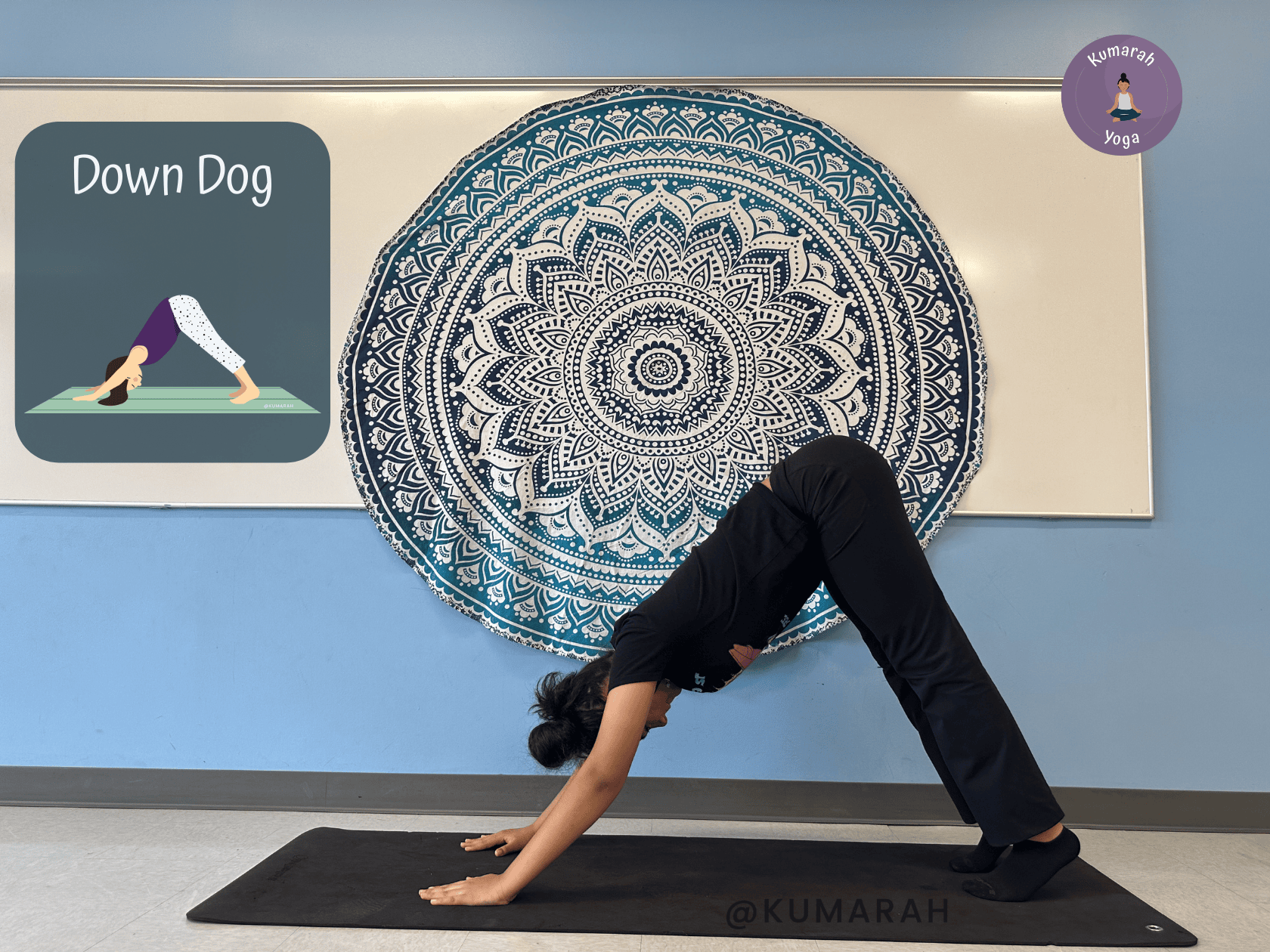
Down Dog Tunnel Bowling
This is like the block bowling above, but without the blocks and kids are the “pins” instead!
10 kids make a bowling pattern while in Down Dog pose, or tabletop pose.
One person rolls the ball towards the “pins”. If the ball goes under the person, they stand up and move to the side (they’ve been knocked down).
See how many rolls it takes to get all 10 Dog Pins “bowled over”! 4 in the middle, 2 on each side, 1 on each end. It sometimes works better to have the kids closer together, overlapping a bit.
For added excitement, you can split the kids into two groups and have them compete to see which group can knock down all the “pins” first.
Also, remind the kids doing down dog, to keep looking back at their own feet (not over at the bowler, as tempting as that is). You want them to keep their form as best as they can and not hurt their neck.
Breathing and Relaxation for Kids Yoga Games
Breathing activities and relaxation techniques are key elements of kids yoga. Adding a simple prop can make these calming moments more engaging, turning them into yoga games that teach mindfulness and focus.
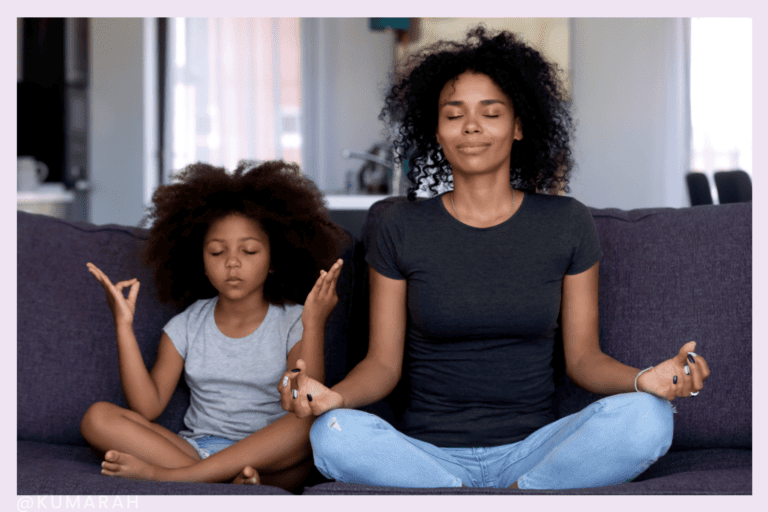
At the beginning of the activity, it’s important to set clear instructions and expectations so everyone knows what to do. If you’re teaching yoga to kids—whether at home, in a classroom, or a studio—these ideas are easy to adapt for different ages and group sizes. Start by gathering the group in a circle. Invite them to sit comfortably, holding a small object gently in their hands or resting it on their belly. Guide them to notice how it moves with each breath. This simple activity helps kids connect with their breath and develop body awareness.
For a playful twist, try a yoga game where the object is passed around the circle while music plays. When the music stops, the child holding it leads the rest in a breathing activity of their choice. This combines movement, focus, and relaxation, making it a great way to transition from high energy to calm. Kids love to be able to make choices and be leaders so this is a great way to incorporate autonomy.
Props can also be used in yoga poses to make them more engaging. For example, place a blanket or stuffie on the back in Child’s Pose for comfort, or challenge kids to balance something on their head or hand in Tree Pose. These small changes add an element of fun, while also helping with balance and concentration. Older kids may enjoy the challenge of balancing during slow, deep breaths—building both focus and control.
To make your kids yoga games even more creative, use yoga pose cards for guidance. Cards showing poses with props help children follow along easily, especially in larger groups or with younger kids. For more creativity, invent yoga stories where the prop becomes a character on an adventure, inspiring kids to move, breathe, and imagine together.
Every child is unique, so be sure to offer modifications and gentle encouragement. The goal is to create a safe, welcoming space for kids to explore yoga at their own pace.
Incorporating breathing exercises and fun yoga games into your sessions helps children develop mindfulness, balance, and social-emotional skills—all while having fun. These activities are also a great way that kids learn important skills such as self-regulation, focus, and cooperation through engaging yoga games and relaxation exercises. These ideas are perfect for indoor recess, rainy days, or anytime you want to bring focus and relaxation to your group. Try them out and watch your students discover the joy of yoga, one breath at a time!
Yoga Games with Poses and Yoga Cards
For more inspiration, try creating a group yoga flow where everyone transitions smoothly between poses. Play a game where kids pretend to have a secret power and come to life as different statues or trees, adding a magical twist.
Explore the wide variety of kid’s yoga games to keep sessions fresh and engaging. These activities bring energy, joy, and life to children’s lives, supporting their well-being through movement and mindfulness.
Use a yoga book or kids yoga cards to introduce new poses, or let children pick a yoga card as a visual aid. Plan a new yoga game each week to keep things exciting. Try a group challenge where the third person in each team has a special role, or play ‘Around the World Yoga’ to explore poses from different cultures.
Games like ‘Red Light, Green Light Yoga’ add fun cues for movement and stillness. Encourage parents to join in, making children’s yoga a holistic practice that connects families and supports kids both at home and in class. These playful ideas help children experience the positive impact of yoga in their world.
We love games in my room and almost always play them on “Fun Friday”
–though I try to remind them that every day is fun 🙂



Hi, thank you so much for all of your free online resources and information about teaching yoga to children, I really appreciate it . There is just one thing,
please do not assume that because I do not use instagram it means I do not want to help out. It means that I have ethical reasons for choosing not to use the app.
Thanks again!!
Hi Louise!
No worries I get that not everyone is on Instagram. I appreciate you being here though! Let me know if there is anything you need, you can always email me directly at admin [at] kumarahyoga.com
Thanks again,
Maia