
Summer camp is a time for games, movement, and making memories — and yoga games for kids fit right in. Whether you’re running a full kids yoga summer camp or weaving mindfulness activities into an existing program, the right games can transform the energy of a group instantly.
In this post, you’ll find everything you need: tips for how to run a kids yoga summer camp, a roundup of the best yoga games for large groups, and two brand-new games to add to your toolkit. There’s also a free printable at the end for one of our all-time favorites.
Let’s dive in.
Why Yoga Games Work So Well at Summer Camp
Summer camp games already teach kids so much — cooperation, coordination, teamwork, and how to win and lose gracefully. Yoga takes all of that and layers in body awareness, breath, focus, and self-regulation.
When you combine movement-based camp games with yoga skills, kids get an experience that’s competitive enough to keep them engaged, physical enough to burn off energy, and mindful enough to actually help them regulate. That’s a pretty powerful combination.
Skills kids build through yoga camp games include:
- Cooperation and teamwork
- Coordination and balance
- Body awareness and concentration
- Physical endurance and flexibility
- Emotional regulation and self-esteem
- Memory improvement and listening skills
- How to win and lose gracefully
Skills at camp mean skills for life.
How to Run a Kids Yoga Summer Camp: Tips Before You Play
Before you jump into games, a few practical things make the difference between a chaotic session and a smooth one. Here’s what I’ve learned from running kids yoga programs in schools and camps for over a decade.
1. Know Your Group Size and Ages
Most of the games in this post work well with 8 to 30 kids. Above 30, consider splitting into two groups with a helper leading one. Age matters too — kids under 6 do better with shorter, simpler games with fewer elimination rules. Ages 7 and up can handle more complex commands and friendly competition.
2. Always Demo the Game Before You Play
This is the single biggest tip I can give you. Before a single round begins, show the game yourself. Then have one or two kids demonstrate. Then ask the group what they noticed about the rules. This takes maybe 3 minutes and saves you 10 minutes of confusion and chaos mid-game.
3. Start With No Eliminations
For any elimination game, run the first 2-3 rounds with everyone staying in — no one gets out. Let kids learn the commands and feel successful before the competitive piece kicks in. You’ll end up with better, longer rounds because everyone knows what they’re doing.
4. Set Clear, Simple Rules for Your Space
Before any game, establish your non-negotiables for the space you’re in. Mine are always: keep your body to yourself, no screaming indoors, and if something breaks or falls, the game stops immediately. State these once, clearly, before you start — not mid-game when someone inevitably tests them.
5. Build in a Calm-Down at the End
Active yoga games get kids genuinely excited — which is the whole point. But plan for a 3 to 5 minute wind-down at the end: a breathing exercise, a guided relaxation, or just everyone lying in savasana for a minute. It closes the energy loop and helps kids transition back to whatever comes next.
6. Have Pose Cards Available
For games that involve choosing poses freely (like Museum or Stuffed Animal Balance), having visual pose references on the wall or on a screen helps kids expand beyond the three poses they already know. The more poses they have access to, the richer the game gets.
The Best Kids Yoga Summer Camp Games
These games work for summer camps, school programs, studio classes, and anywhere you have a group of kids who need to move. Most need little to no equipment.
Ship’s Captain:
Best for: Ages 7+
Group Size: At least 10, up to 40 would be possible.
You’ll Need: A large space with defined borders.
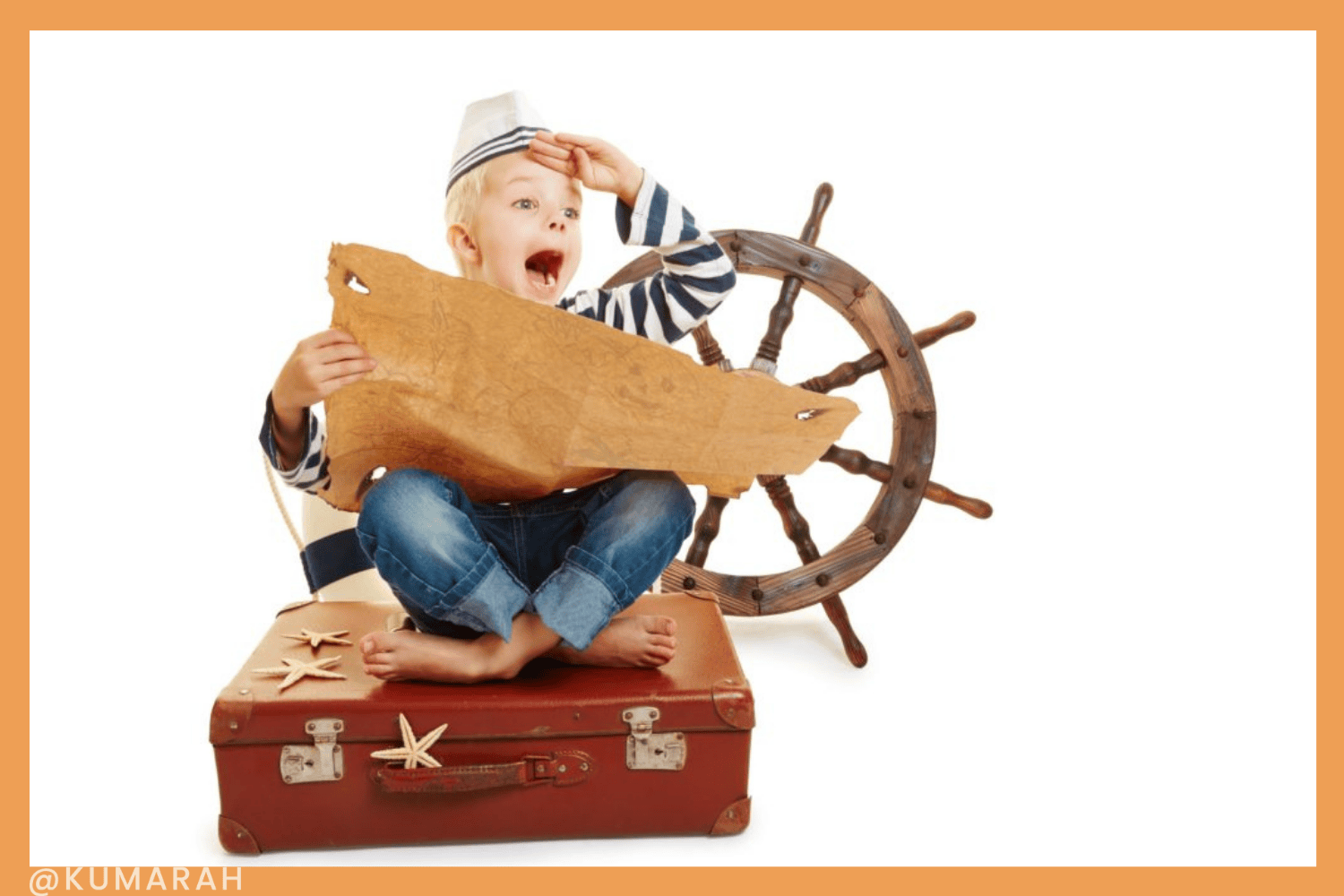
This is the game kids ask for by name, every single year. It’s the one I’d call the crown jewel of kids yoga summer camp games — it’s competitive, physical, hilarious, and full of yoga poses in disguise.
The premise: your group is the crew of a pirate ship. One person is the Captain and calls out commands. The crew has to respond instantly. Last one to complete the task (or the wrong group size) is out. Last crew member standing wins — and gets to be the next Captain.
Before you start, draw or post a simple diagram of a ship with the four directions labeled (bow = front, stern = back, port = left, starboard = right). Run the first few rounds with no eliminations so everyone gets the hang of it.
The Captain’s Commands:
Bow: Run to the front of the ship
Stern: Run to the back
Port: Run to the left
Starboard: Run to the right
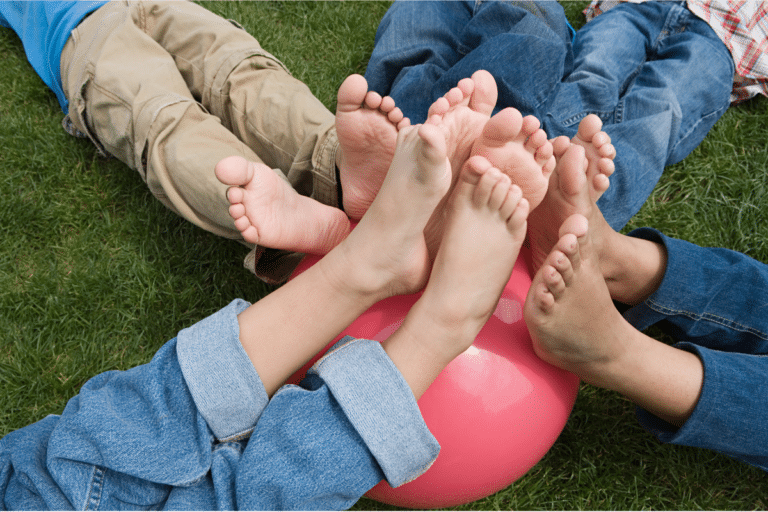
Row Your Boat: Find a partner, sit face to face, hold hands, feet up in boat pose, sing Row Your Boat
Hit the Deck: Lay flat on your stomach (or crouch down if they don’t want to get dirty)
Attention on Deck: Kneel on one knee, salute, and yell “Aye, aye captain!” — no moving until the Captain says “At ease!”
Man the Lifeboats: Form groups of three in a vertical line, hands on shoulders
Scrub the Deck: On knees, scrubbing
Captain’s Quarters: Everyone runs toward the captain
Man Overboard: Find a partner fast — one does shark pose (on stomach), the other stands over them
Submarine: On your back, one leg straight up like a periscope
SHARK!: Everyone does dolphin pose
Crow’s Nest: Tree pose — fall and you’re out
Sick Turtle: Happy baby on your back
Walk the Plank: Groups of three — two do open heart pose, one does high plank in front
Hoist the Sails: Find a partner and do rooftops pose — hands touching overhead, arms straight, making a triangle
👉 Grab the free printable of Ship’s Captain rules in the Kumarah free resources library!
nmNinja
Best for: Ages 7+
Group Size: 8-25 kids
You’ll Need: Enough space to make a large circle
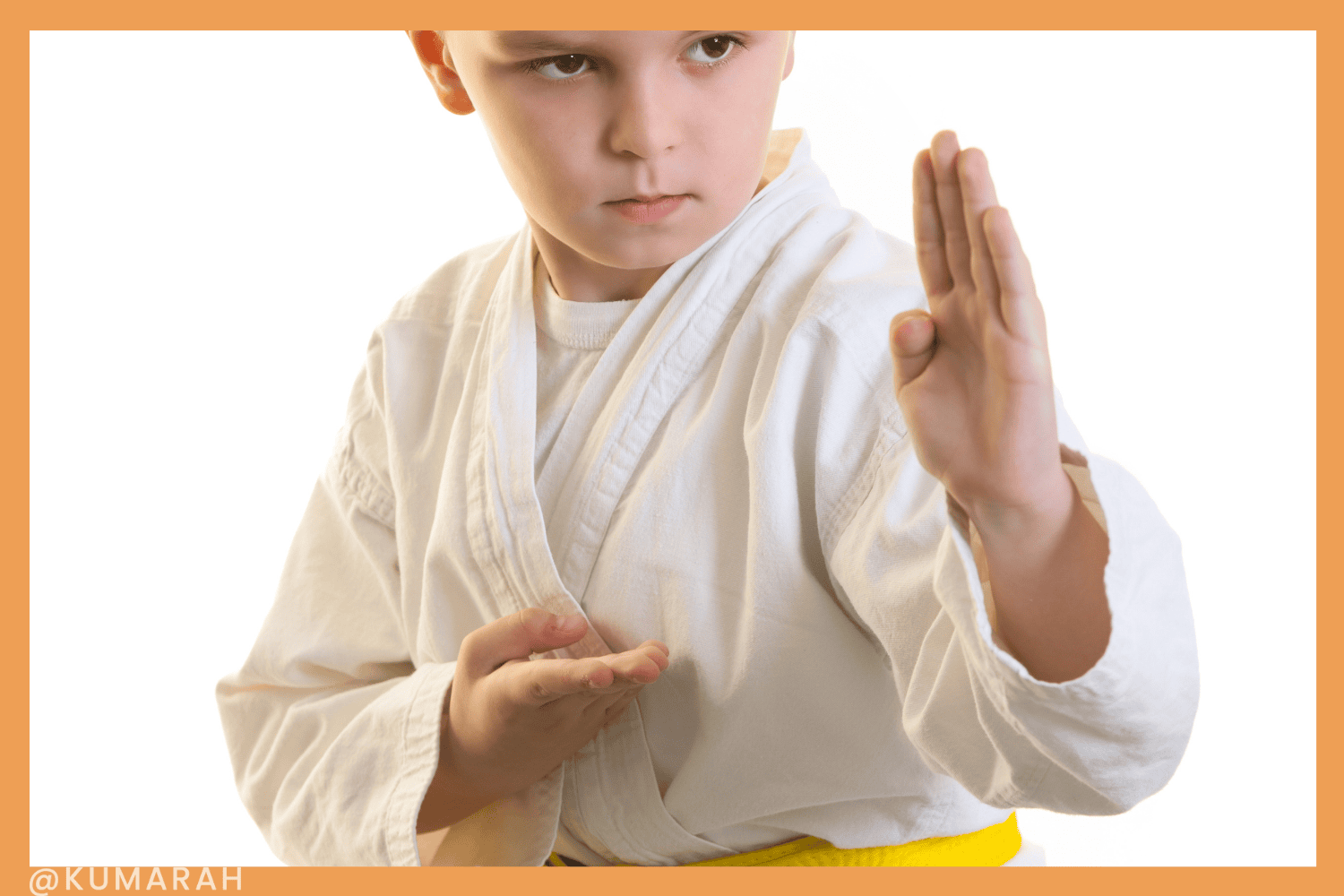
Ninja is perfect for rainy days, limited space, or anytime you need a game that runs itself once the rules are established. It works indoors or outside and kids get genuinely competitive about it.
Ninja is perfect for rainy days, limited space, or any time you need a game that runs itself once the rules click. It works indoors or outside and kids get genuinely competitive about it.
Everyone starts in a tight circle, shoulder to shoulder, hands in the middle. On the count of three, everyone jumps back into a “Ninja pose” — arms up, feet apart. Then players take turns: the attacker tries to tag another player’s hand or arm in a single move. The defender can dodge with a single move. Everyone else stays frozen.
Rules:
- Each attacker has only ONE Ninja move per turn, whether they miss or connect
- After the attempt, both players freeze in their new positions
- If your hand is touched, put that arm behind your back — lose both arms and you’re out
- The player to the right goes next (or call names randomly to keep them on their toes)
- Last Ninja standing wins
Tip: encourage players to hold a yoga pose between turns. It keeps energy focused and adds a mindfulness layer to the competitive game.
Arm Hockey
Best for: Ages 5+
Group Size: 10-30 kids
You’ll Need:
- Space to make a large circle
- A ball (or two) to push around
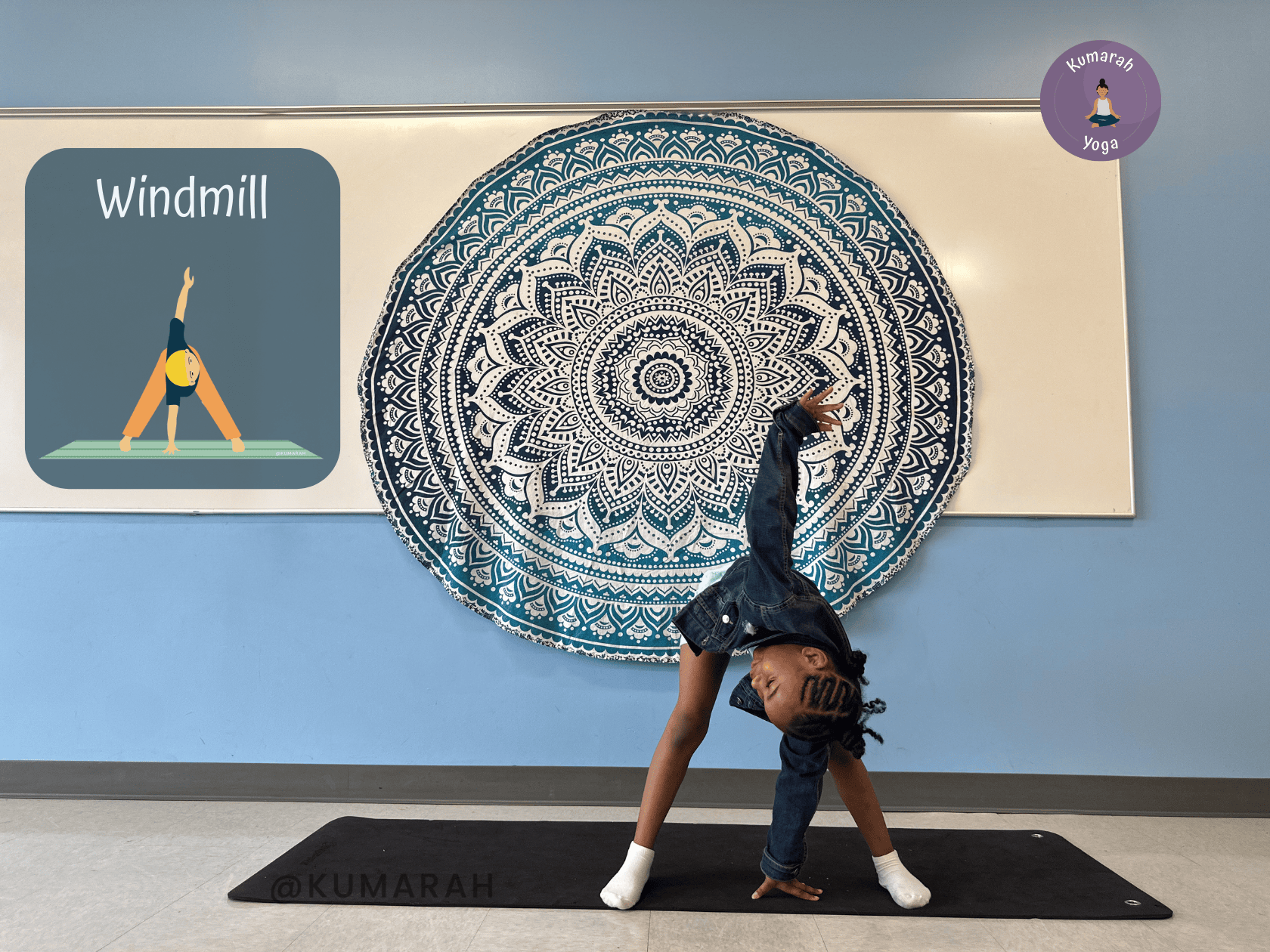
This one I learned from a P.E. teacher and it’s become a staple — faster-paced and higher energy than most yoga games, which makes it great for older kids who need a real outlet.
Start by teaching the group wide-legged forward fold: feet wider than hip distance, toes forward, hinge at the hips and reach toward the ground (knees can be slightly bent). Once everyone’s got it, form a circle with feet touching the person on either side — this is the setup pose the whole game is played in.
A ball goes in the middle. Kids try to roll it through someone else’s legs to score a goal, while defending their own goal by hitting the ball away with flat hands. When the ball goes through your legs, you’re out — either leave the circle, or stay seated in wide-legged forward fold (they can still block but can’t grab).
Rules:
- Push with a flat hand only — no fists
- Ball stays on the floor
- Feet stay glued — no stepping into the circle
- Keep the ball moving — no grabbing or stopping it
Add a second ball once they get good at it. Chaos ensues. Kids love it.
Sea/Shore/Shells
Best for: Ages 4+
Group Size: Any group size
You’ll Need:
- A long rope, sticks, or chalk to draw a line dividing an open space.
- Some yoga cards if you want to show them options for poses
This is a yoga spin on the classic sea/shore game — easy to explain, fast to play, and endlessly entertaining for younger kids. It’s also great for sneaking in pose practice without it feeling like a lesson.
Draw or lay a line dividing the space in two. One side is the “sea,” the other is the “shore.” The caller shouts “sea!” or “shore!” and everyone jumps to the right side. But when the caller yells “shells!” — everyone has to freeze in a yoga pose.
The last one to pose, or anyone who jumps to the wrong side, is out. The key is to go quickly and mix it up — repeat “sea” a few times in a row, then throw in “shells” to catch them off guard.
Start by giving kids 2–4 pose options to choose from. Make it harder in later rounds by calling a specific pose for “shells,” or adding a rule that no two players can hold the same pose. Great for listening skills, reaction time, and getting silly fast.
Yoga Statues (Museum / Red Light Green Light)
Best for: Ages 5+
Group size: 8–30 kids
You’ll need:
Open space + pose cards on the wall recommended
This game can be played two ways — pick the one that fits your space and group best.
Version 1: Museum (Night at the Museum)
One person — the Curator — stands in the middle of the circle. Everyone else is a statue holding a yoga pose. When the Curator’s back is turned, statues can “come to life” and slowly shift into a different pose. If the Curator catches them moving, they’re out and sit in Yogi Style (upright, hands in a mudra on their knees) — this keeps them engaged and working on core strength while they wait. After a minute, let them re-enter. Last statue standing wins and becomes the next Curator.
Version 2: Red Light / Green Light
One person is the caller at one end of the space. Everyone else lines up at the other end. Green light = walk toward the caller in a flowing yoga movement. Yellow light = slow motion. Red light = freeze in a yoga pose. Anyone caught still moving goes back to start. The first person to reach the caller wins.
Tip: post yoga pose cards on the wall before you play — kids who can see their options choose much more interesting poses. For the Red Light version, calling out a specific pose on red light adds a memory challenge.
Yoga Obstacle Course
Best for: Ages 5+
Group size: 8–30 kids
You’ll need:
Yoga mats, blocks, cards — more props = more fun
Optional:
- Yoga mats
- Yoga blocks
- A Yoga strap
- Kid’s Yoga cards of your choice
- Straws and cotton balls
- Hula hoops
- Exercise ball
- Jump ropes
- Small bell
- Bean bags or beanie babies
- This small set of obstacle course tools is a great start!
This one takes the most setup but delivers the biggest payoff — ideal for the last day of camp, a special event, or any time you want to go all out. Set up stations around your space, each with a different yoga challenge. Kids move through as fast as they can — solo, in pairs, or as relay teams.
Station ideas:
- Walk across yoga blocks like stepping stones
- Pose card station: flip a card, hold the pose for a count of 10
- Partner poses checkpoint — both partners must nail the pose before moving on
- Balance beam (tape on the floor) in tree pose
- Frog leaps over teammates holding child’s pose
- Tunnel crawl in cat pose
- Animal movements across the mats
Want to go bigger? Set it up as a full Olympic Games event across several days. Double the course for relay races. Add a sand timer at each station. The obstacle course is infinitely adaptable — which makes it one of the most reusable games in your toolkit.
Hula Hoop Pass
Best for: Ages 5+
Group Size: At least 5
You’ll Need:
A Hula Hoop
Gather in a circle and hold hands to connect everyone together.
The goal is to pass a hula hoop all the way around the circle without letting go of any hands.
Un-connect the hands of two people who will start, and let them know which way they need to pass the hula hoop.
Encourage each other to lift their arms, duck their heads, step through, etc. to get the hula hoop to move around the group.
Works on flexibility, teamwork, positive encouragement, and creativity.
What’s My Pose?
Best for: Ages 6+
Group Size: 8-30 Kids
You’ll Need:
Yoga Pose Cards
A yoga twist on charades — and one of the best games for building pose vocabulary without it feeling like memorization. Kids love being the one in the spotlight, and it gets genuinely funny fast.
One player draws a pose card (or the leader whispers a pose to them) and acts it out without saying anything. The rest of the group tries to guess the pose. First correct guess wins the next turn. You can play in teams for older kids and keep score.
Variations: let the guesser only ask yes/no questions (“Is it a balance pose?” “Does it involve the floor?”). Or add a 30-second timer for extra pressure. This game works especially well at the start of a session to introduce new poses, or mid-camp as a brain break.
Yoga Freeze Tag
Best for: Ages 5+
Group Size: at least 5
You’ll Need:
a wide open space
Depending on how many kids, choose a person to be “it” and another person to be the “defroster.” With more kiddos, you can add more “defrosters.”
The person who is “It” runs and gently tags the other kiddos. As they are tagged, the person who is It says a yoga pose (one that everyone knows) and the frozen person must do the pose.
The defroster’s job is to unfreeze the kiddos in yoga poses.
As they get to each frozen child, they do the pose that the frozen kiddo is doing with them for two breaths.
Then the frozen kiddos can get up and run again!
It’s a good idea to let the person who is “It” know that they should not stand next to the frozen kiddos as they are defrosting. Give them a chance to get up and run again, that’s more fun!
Stuffed Animal Balance Challenge
Best for: Ages 4+
Group size: Any size
You’ll need:
One stuffed animal or beanie baby per child
This one looks simple and turns out to be surprisingly tricky — kids are immediately hooked. Give each kid a stuffed animal and challenge them to keep it balanced on their body as you move through a yoga sequence together.
Start in easy poses (mountain, star, standing forward fold) and let kids experiment with where to balance their animal. Then move into more challenging territory — warrior, tree, downward dog, child’s pose. Animal falls? They find a creative way to rebalance and keep going.
For older kids: add a rule that the animal must be balanced on a different body part for each new pose. For younger ones, any balance counts. Use a yoga card deck and flip poses one at a time — kids strike the pose and balance their animal. Silly, engaging, and full of real balance and body awareness work underneath the fun.
Yogi Freeze Dance ✨
Best for: Ages 4+
Group size: Any size
You’ll need:
Music + a way to pause it
Classic freeze dance — with a yoga twist. Music plays, kids move freely. When the music stops, everyone freezes in a yoga pose. Simple, zero prep, works for any age.
For younger kids, let them choose any pose they know. For older kids, call out a specific pose when the music stops and see how quickly they can find it. Tie it to your camp theme — ocean poses, jungle animal poses, superhero poses — for extra engagement.
This is a great opener or warm-up. It gets energy moving, gets kids laughing, and introduces pose vocabulary in the lowest-stakes way possible. It also happens to be the easiest game to run when you need something fast with no setup.
Bonus: Yogi Says
Best for: Ages 4+
Group size: Any size
You’ll need: Nothing!
Simon Says — but make it yoga. “Yogi says warrior two… Yogi says tree pose… downward dog!” (No “Yogi says” = don’t move.) Zero prep, works for any age, perfect as a filler, warm-up, or quick brain break.
Use this huge list of prompts to keep the game going for as long as possible.
For younger kids, drop the elimination and just play for fun. For older kids, speed it up and use less familiar pose names to keep them sharp. Flip the roles and let a kid be the Yogi — they absolutely love being in charge.
Wind in the Trees
Best for: Ages 5+
Group size: Any size
You’ll need:
Open space, optional music
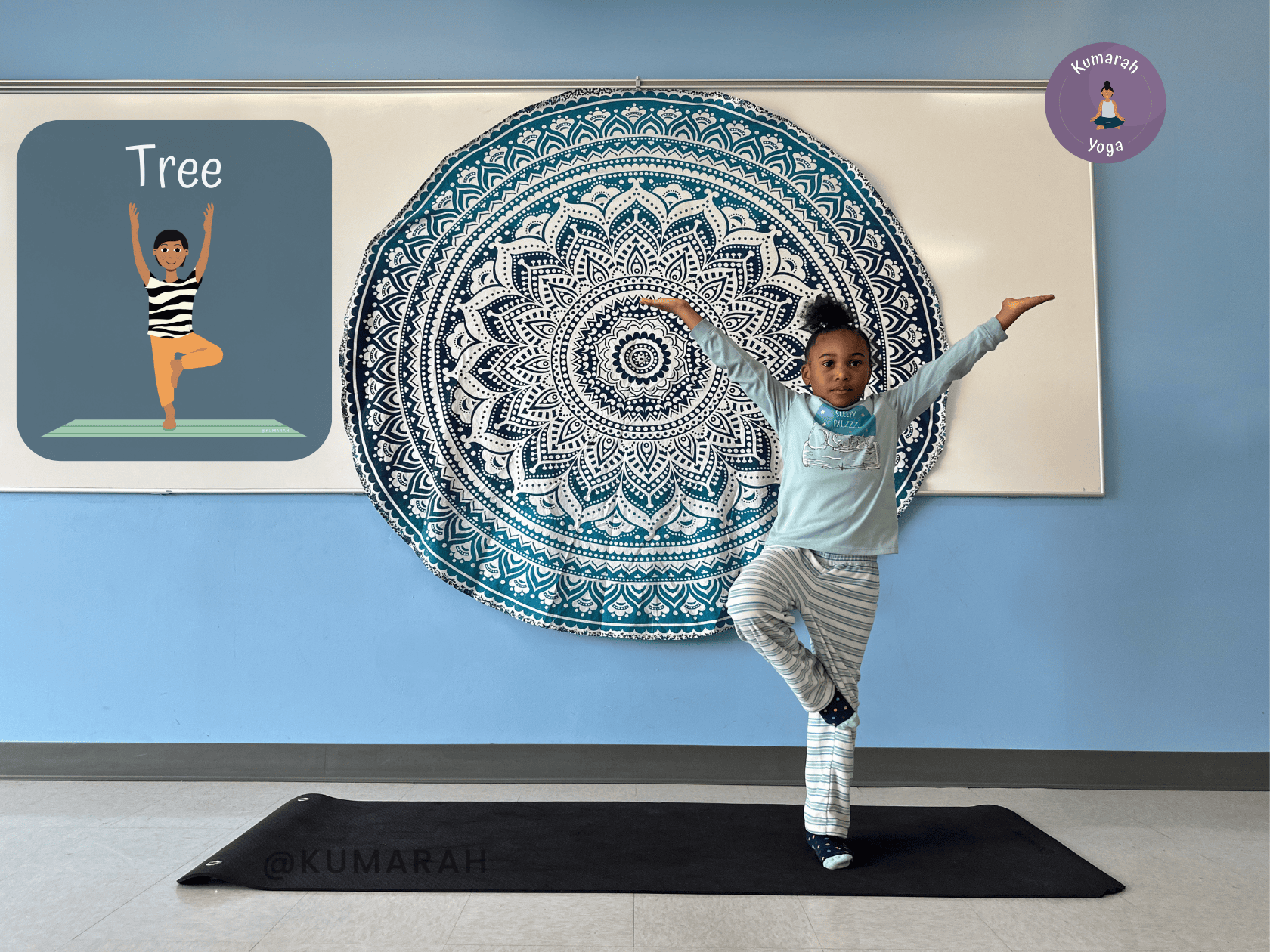
A calmer, more imaginative game — great for transitions or winding down after high-energy activity. Kids spread out and find tree pose. When you say “the wind blows,” the trees come alive and run freely around the space. When you say “the wind stops,” everyone freezes back in tree pose — this time on the opposite foot.
Add music: play something breezy and flowing while they move, pause it to signal the freeze. When they’re back in tree pose, cue a breath: “feel your roots growing down into the ground, feel tall and still.” It’s a lovely transition move.
Frequently Asked Questions About Kids Yoga Summer Camp Games
What yoga games are good for kids at summer camp?
The best kids yoga summer camp games combine movement, friendly competition, and yoga poses in a way that feels like play, not exercise. Top picks include Ship’s Captain, Ninja, Arm Hockey, Sea/Shore/Shells, and Yogi Freeze Dance. These work for a wide range of ages and group sizes and need little to no equipment.
How do you run a yoga class at summer camp?
Start by knowing your group size and age range, then choose games appropriate for both. Always demo before you play, run the first round without eliminations, and set clear space rules upfront. Plan for 5 minutes of calm-down at the end — a breathing exercise or short savasana helps kids transition back to the rest of the day. Pose cards on the wall expand what kids choose in free-choice games.
How many kids can participate in yoga camp games?
Most games in this post work best with 8 to 30 kids. Ship’s Captain can handle up to 40 with a large enough space. For groups larger than 30, split into two groups with a helper leading one, or choose games like Yogi Freeze Dance and Yogi Says that scale to any size.
What do kids do at a kids yoga summer camp?
A kids yoga summer camp typically combines yoga movement and poses, mindfulness and breathing activities, cooperative and competitive group games, creative activities like storytelling and art, and relaxation techniques. The best camps balance active games with quieter mindfulness moments throughout the day — giving kids tools for self-regulation and body awareness while making sure they’re having a genuinely great time.
Do kids need yoga experience to play these games?
Not at all. These games are designed to introduce yoga poses through play, so kids learn as they go. Teaching 5–6 poses at the start of a session gives kids enough vocabulary to jump in with confidence. The games do most of the teaching from there.
Ready to Teach Kids Yoga This Summer?
If you want to go deeper — with full lesson plans, sequencing guides, pose cards, and a complete curriculum for teaching kids yoga — the Kumarah Kids Yoga and Mindfulness Teacher Training has everything you need. It’s self-paced, comprehensive, and designed for people who want to bring yoga and mindfulness to children in camps, classrooms, studios, and homes.
→ Learn more about the Kumarah Teacher Training
And don’t forget — the free printable for Ship’s Captain rules is waiting in the Kumarah free resources library. It’s one of the most-used downloads in there, and once you play this game you’ll know exactly why.
→ Access the Free Resources Library
Happy camping! 🏕️



These are amazing and will be playing them in my yoga class! Thank you for sharing!!
Hi Julie!
I’m so glad you like them. I hope they bring joy and fun to your yoga class, let me know how it goes! 🙂
Maia
What a great collection of games! I’ve been looking for some games like this to make yoga class more fun and interactive. Can’t wait to play. Thank you! Carla
You’re welcome, Carla! I hope the yoga games help out your classes, let me know how it goes!
-Maia
Awesome! I’m always looking for new and fun ideas, as well as twists to make it “yoga” in a classic kids game. Thank you for these great ideas!
Great ideas!!! Thank you!
You’re welcome, Diana! Have fun with them 🙂
Thank you so much for wonderful ideas !
You’re welcome! I hope your kids enjoy the yoga games 🙂